Mihai Vodă Monastery is one of the most significant edifices built by Michael the Brave, constructed in 1594, before he ascended the throne. Listed as a historical monument of national importance, the monastery has weathered the centuries with a particularly tumultuous history, marked in the final decades of the last century by an unprecedented episode: in the 1980s, under the communist regime, the complex was partially demolished, and the church itself was moved from its historic site to make way for the construction of the People’s Palace.
In the first half of the 19th century, the monastery complex underwent a series of functional transformations. In 1825, the complex’s buildings were refurbished to serve as the princely residence of Grigore IV Ghica, the first native prince of Wallachia, a situation that persisted until 1828. During the Russo-Turkish War of 1828–1829, the princely residences were converted into a hospital for the Tsarist army; after the conflict ended, they continued to serve as a military hospital, this time for the Romanian army. Between 1855 and 1862, the School of Medicine operated in these same buildings.
Following the Union of the Principalities and the laws secularizing monastic property, monastic life came to an end, and in 1864 the former monastery was converted into the headquarters of the State Archives, thereby becoming the property of the Romanian state. Toward the end of that same century, in 1877, the premises also housed one of the capital’s district city halls, as well as the district police station. A major restoration of the entire complex was undertaken in 1900, under the coordination of historian Dimitrie Onciul, then director of the State Archives.
Starting in 1920, the former monastery took on a new symbolic role, becoming the headquarters of the Knights of the Order of Michael the Brave and the place where decorated military personnel took their oath of allegiance. During the interwar period, between 1928 and 1935, the buildings underwent a new phase of restoration, coordinated by the Commission for Historical Monuments under the guidance of architect Emil I. Costescu, during which painter Costin Petrescu restored the interior paintings.
By Decree-Law No. 2368 of June 26, 1939, the Mihai Vodă Church was transferred to the ownership and administration of the Ministry of National Defense, to serve as a place of worship for the Knights of the Order of Michael the Brave. Given the advanced state of disrepair of the building, the Ministry of National Defense, through the Directorate of Military Estates, began restoration work as early as September 1939, with the approval of the Ministry of Religious Affairs and Arts. Subsequently, by Decree No. 3568 of October 23, 1940, the church was officially converted into an army chapel, receiving the name “Voivode Michael Military Church” and coming under the canonical jurisdiction of the Military Bishop, pursuant to Decision No. 1972 of 1939 of the Holy Metropolis of Ungro-Wallachia. At that time, it was also stipulated that a bronze plaque bearing the names of all the Knights of the Order be affixed to the north wall of the entrance.
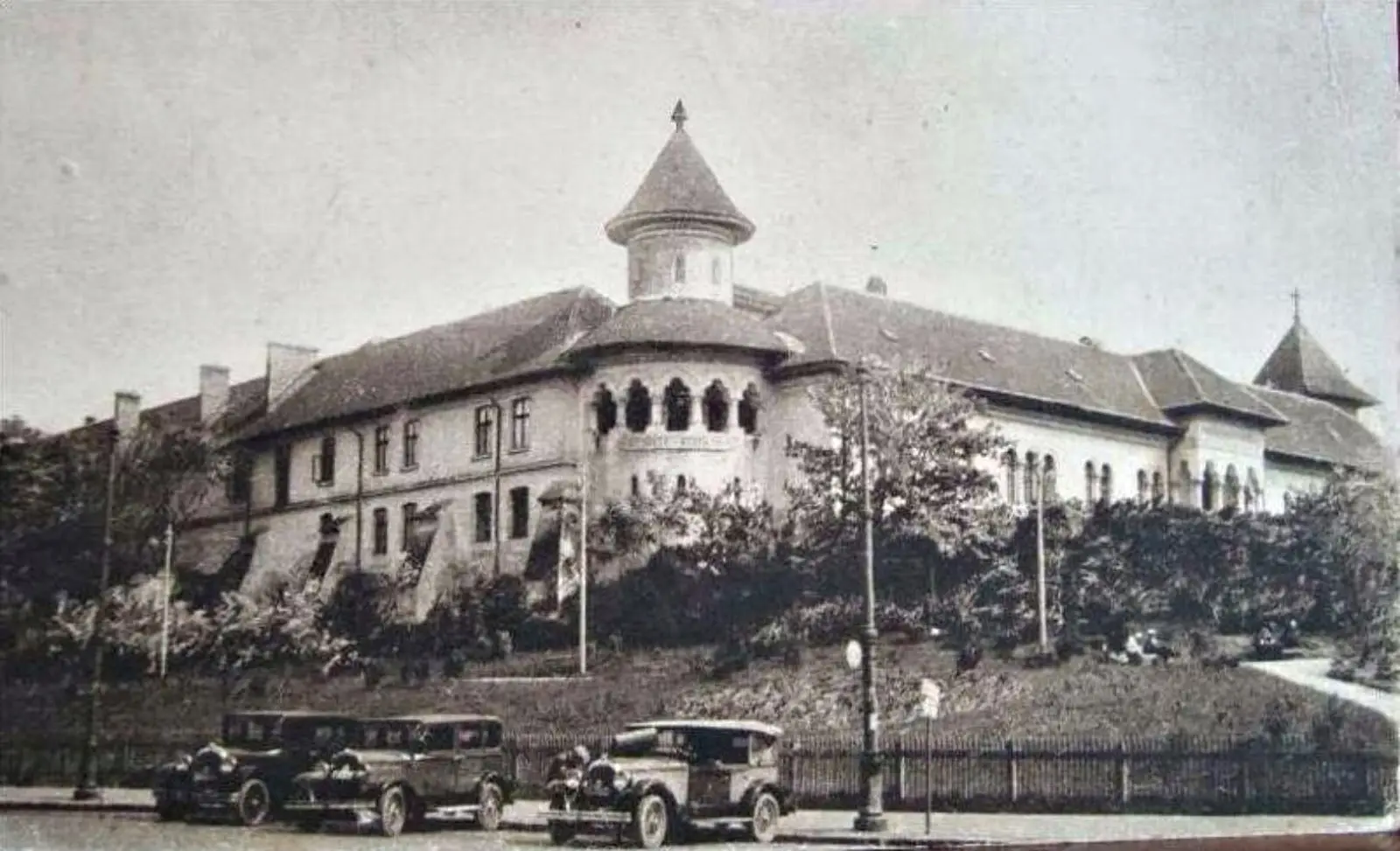
The monastic complex of Mihai Vodă Monastery – early 20th century
From an organizational standpoint, the church was served by an active military priest, and its property was administered by the Ministry of National Defense through a board of trustees composed of four members appointed for a three-year term, three of whom were typically required to be Knights of the Order. Between 1939 and 1941, extensive restoration work was carried out, which included the restoration of the interior paintings as well as the altar.
The iconographic program created for this occasion eloquently reflects the dual identity of the site—a princely foundation and a military church. The votive paintings depict, on the one hand, the founders of the former monastery—Michael the Brave and Lady Stanca— and on the other, King Ferdinand and Queen Maria, as founders of the “Mihai Viteazul” Order, established by High Decree No. 2968 of September 26, 1916, and ratified by High Decree No. 3249 of December 21 of the same year. Added to these are scenes atypical for a parish church but natural for a place of worship intended for the military: depictions of Romanian soldiers on the front lines, alongside figures of Romanian peasants.
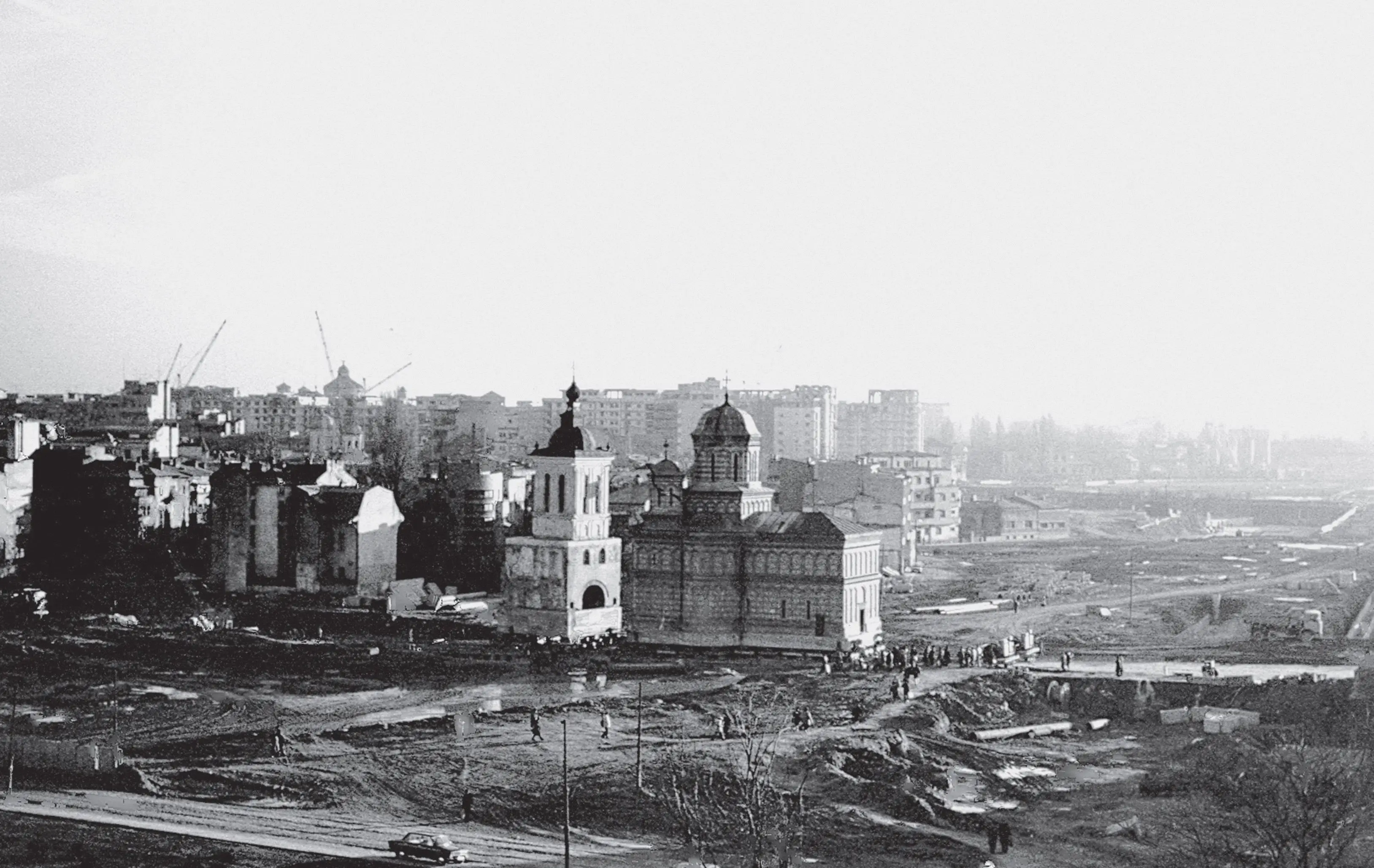
In January 1985, the communist authorities decided to completely demolish the monastery complex, and the enclosure walls, cells, and annexes—including the imposing State Archives Palace—were razed from their historic site. Thanks to the firm protests of the Romanian Patriarchate and the petitions submitted by several intellectuals of the time, the voivodal church and the bell tower were nevertheless saved through an unprecedented technical solution: the relocation of the two buildings to a new site. The operation, coordinated by engineer Eugeniu Iordăchescu of the “Proiect” Institute in Bucharest, was carried out in the fall of 1985 and involved moving the church a distance of 289 meters horizontally, accompanied by a vertical descent of 6.2 meters, to its current address on Sapienței Street.
The church remained closed for nearly a decade, reopening to the faithful only in 1994 and resuming its function as a parish church, with Father Adrian Beldianu appointed as parish priest. Extensive restoration and renovation work was undertaken, including the restoration of Costin Petrescu’s Neo-Byzantine painting by artists Mihai and Ștefania Stinghe; the miraculous icon of the Mother of God “Hodighitria” was restored by Irina Petrescu, and the interior was refurbished by restoring the pews and laying marble flooring. In 2004, the human remains stored in the bell tower during the relocation were buried with due honor in the churchyard, the site marked by a carved stone cross.
The church was moved approximately 280 meters from its original site
On May 1, 2026, more than a century and a half after monastic life was interrupted following the secularization of the monastery’s assets, Mihai Vodă Monastery was officially reactivated under the care and with the blessing of His Beatitude Daniel, Patriarch of Romania. The restoration of the monastic community was arranged to mark the 425th anniversary of the death of the founding ruler, Michael the Brave, the first unifier of the Romanian Principalities, who passed away at Câmpia Turzii in August 1601. This act of spiritual restoration brings the place back to its original vocation, concluding a long and often dramatic historical journey, by reestablishing the monastic community within the voivodal endowment and restoring it to the purpose for which it was built: to be a place of unceasing prayer, remembrance, and witness to the forefathers' faith in the heart of Bucharest.