
On the 425th anniversary of the passing of Prince Michael the Brave (1601–2026), the Archdiocese of Bucharest has decided to restore to the Mihai Vodă Monastery in Bucharest the status established by its founder: that of a monastic settlement dedicated to a life of prayer and thanksgiving to God and Saint Nicholas for his deliverance from death.
The year 2026 holds a double significance: it marks 435 years since the monastery was founded by Michael the Brave (1591–2026) and 425 years since the betrayal and assassination of its founder at Câmpia Turzii (1601–2026). These anniversary milestones naturally mark the moment of reactivation, as the true honor paid to the Romanian ruler is fulfilled by restoring his foundation to the monastic life for which it was built.
Above all, the reactivation fulfills the founder’s unwavering will. The prince established this settlement and appointed it as a place of monastic life. Restoring its status as a monastery is, therefore, an act of fidelity to the founder’s own will.
The reactivation also constitutes an act of justice and historical redress for the two blows that interrupted monastic life in this historic spiritual place: the secularization of 1864, which transformed the monastery into the headquarters of the State Archives, and the demolitions carried out by the communist regime in 1984, which destroyed the premises and mutilated the complex.
The reactivation symbolically renews the ancient spiritual bond between the Bucharest foundation and the Simonos Petras Monastery on Mount Athos, where Prince Michael is still honored today as a holy man and founder, remembered at every vigil and memorial service. This communion is sealed by the wonderworking icon of the Mother of God, once gifted to the holy site by the monks of Simonos Petras Monastery and reverently preserved to this day as a visible sign of an unbroken continuity across the centuries.
Within the monastery grounds, a new monastic complex is to be built, which will include cells for the community and spaces for receiving pilgrims, and which will carry forward the spirit, style, and architectural elements of the original, demolished complex in order to restore the holy site to the setting befitting a monastic settlement in the heart of Bucharest.
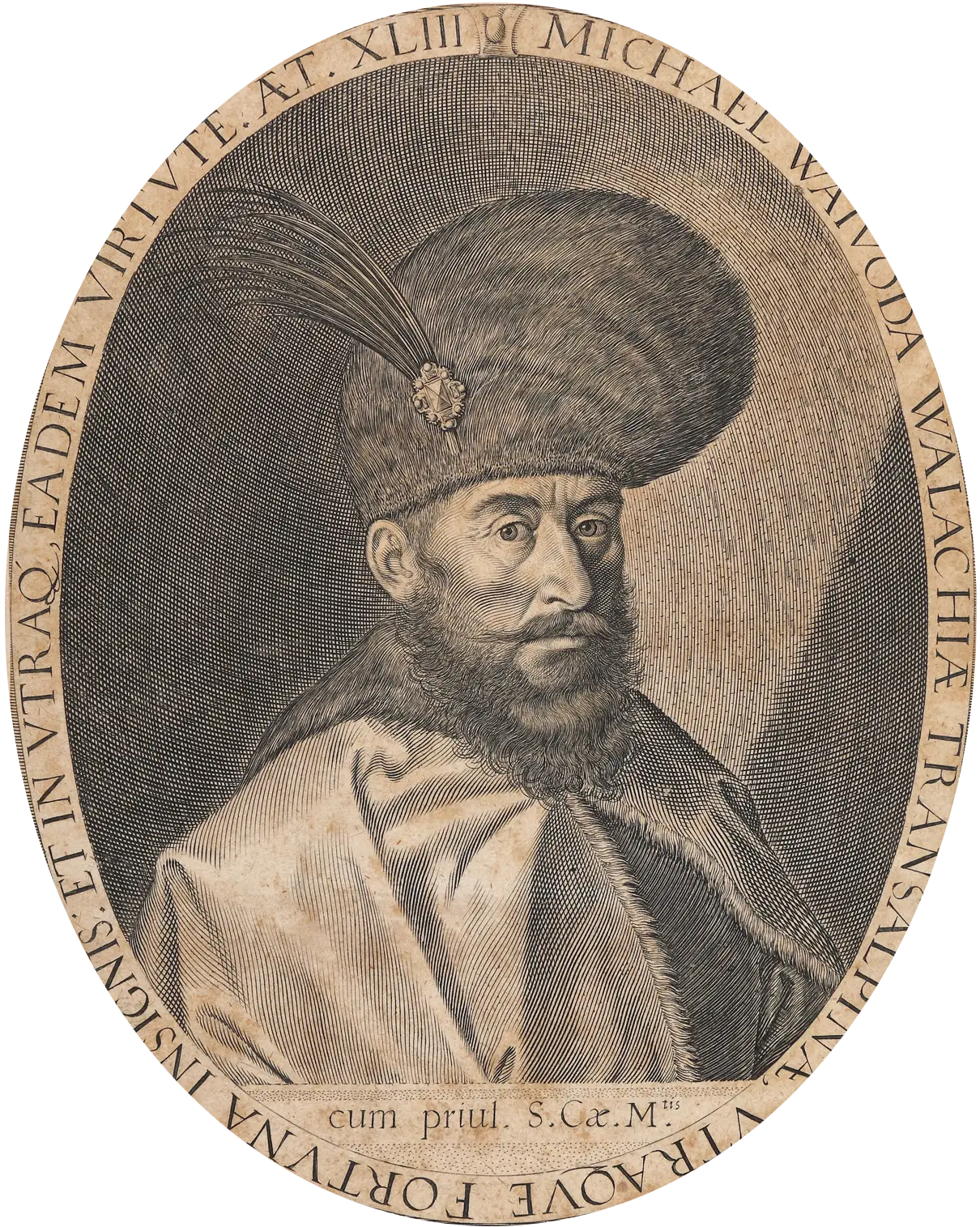
Portret al domnitorului Mihai Viteazul, gravură 1601